Featuredpedals
Here are some of my pedals
- Shaka Express -- Hi-gain distortion with mid control.
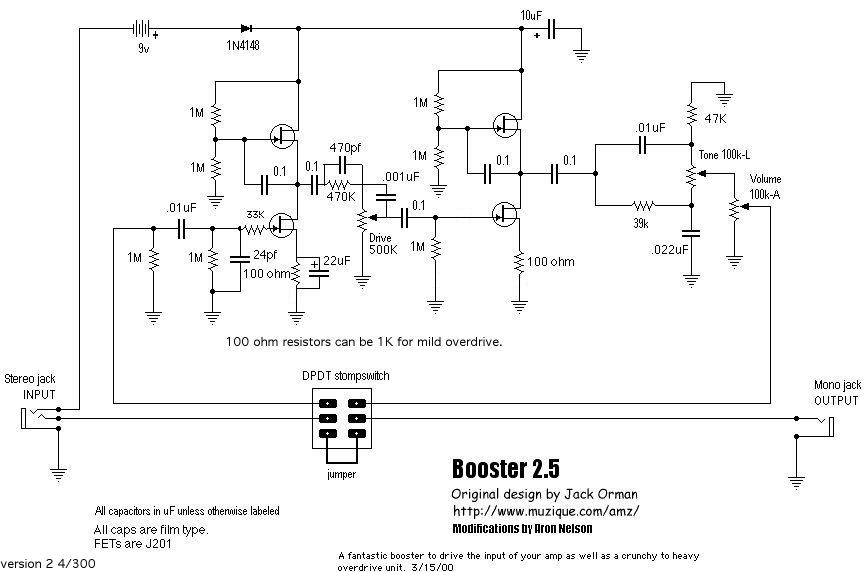
- Booster 2.5 FET overdrive
- The Booster 2.5 is the next generation of the Booster 2 designed by Jack Orman. I refined the circuit based on the refinements Jack put in his Mini-Tubes pedal. The result is a stunning overdrive that has 90% of the wonderful tone of the Mini-Tubes with about 1/3 of the complexity. A great pedal, I am still enjoying mine. Also check out the Sweet Thing which is Doug Hammond's mods to the Booster 2.5.
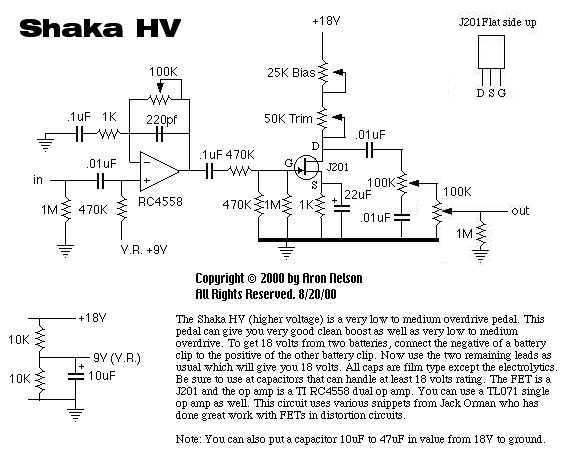
- Shaka HV Higher Voltage Overdrive
- This one is for the guys that like more clean headroom and very little to medium overdrive. When the drive is turned all the way down, you can a great good clean boost. Runs on 18 volts (2 batteries) and has much less drive than my usual pedals! Easy to build and sounds good. HV = higher voltage. If you run it on 30 volts, then change the drive pot to a 500K.
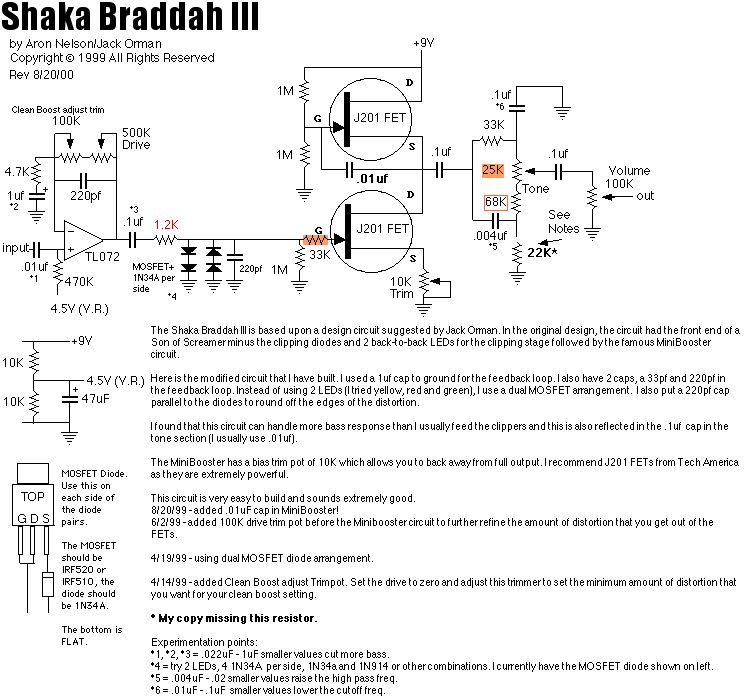
- Shaka Braddah 3 Op amp->FET overdrive
- Shaka Tube Low-voltage op amp->12AX7 overdrive
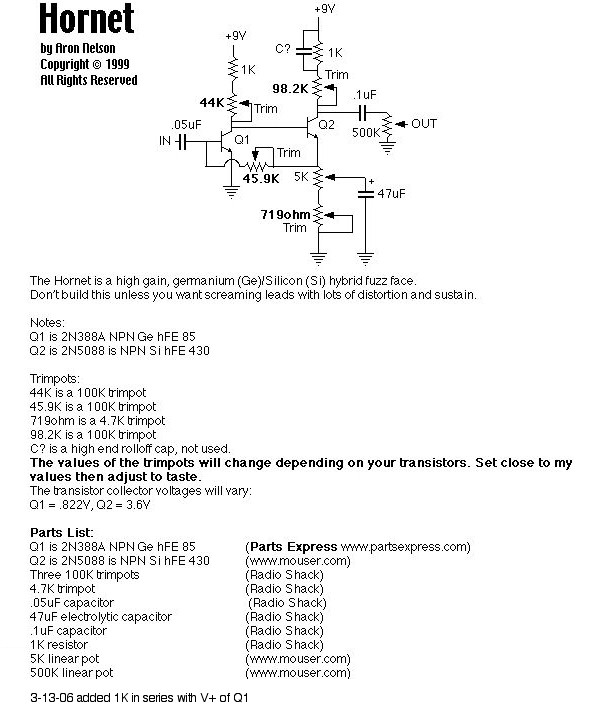
- Hornet Overdrive Fuzz Face-based overdrive
- Notes: A germanium/silicon transistor hybrid Fuzz Face that screams! High gain, high sustain, ANGRY, yet can get bluesy when your guitar pot is turned down. Minimalistic design that can be "tuned" to perfection. Better watch out cause the Hornet will sting The Rocket! The Hornet did not happen without the contributions of the usual netizens that help us so often. Alfonso Hermida, GFR, Gus Smalley, Jack Orman, R.G. and others. Thank you guys!
- 7/11/99 -
- Notes: Not much to this circuit; the trimpots allow you to really tune in and adjust the circuit. The 2N5088s can be readily found through Mouser. The rest is pretty much Radio Shack or your local store. Convert to PNP transistors by changing the orientation of the lone 47uF electrolytic and reversing the battery polarity. (The battery AND 47uF cap POSITIVE to ground).
- Mods: The input cap is critical; for classic fat fuzz tones use 2.2uF to 10uF to larger! (you may consider socketing it - I did) The output cap is less critical; I have found that .1uF is fine for me. The .05uF that I use I have found to be very good because it changes the frequency response of my guitar the least. I have around the same bass as when the unit is bypassed. The trimpots allow you to really tune in the sound. Many shades of distortion will come out as you fool around and turn them. C? is a high end rolloff cap, you can put .001 to .01 to larger values and hear what it does (socket this cap). You can also put the usual 50K pot at the input BEFORE the input cap as described in the Technology of the Fuzz Face - (GEO) Excellent article about the Fuzz Face.
- You could also make the 1K resistor off of Q2's collector a 47K, then make the 100K trim a 47K and tap the output off of the junction between the two. This will reduce your output level and make it a lot tamer.
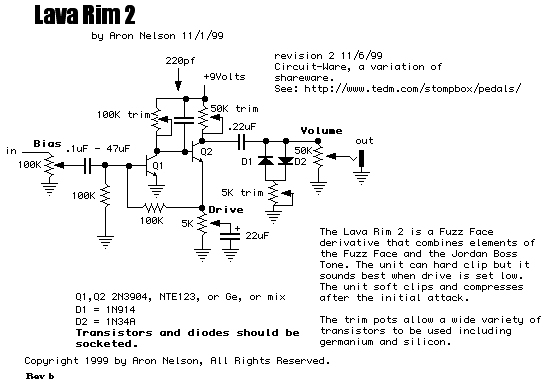
- Lava Rim 2 Everything from soft clip to fuzzed tone
- The Lava Rim revisited.
- Key points about the Lava Rim 2, uses cheap readily available 2N3904 transistors, sounds good and can get creamy - slightly compressed tones with the drive and input pot set low as well as nasty heavier types of distortion. It's also very easy to build and easily adapts to germanium NPN transistors; the trimpots really allow you to dial in a very good tone.
- 11/29/99 - The Lava Rim 2 is a versatile circuit! You can mix NPN germanium transistors and silicon transistors for a unique sound. The trim pots let you use all types of transistors such as the 2N5088 for more distortion and gain. In addition, the 2nd transistor can use a MOSFET like the 2N7000 or BS170! Just pop in the MOSFET, drain toward V+, source toward ground and adjust the trim pot until you hear good tone! In addition, remove the diodes to really hear the MOSFET. Thanks to Jack Orman for the tip on using a MOSFET for the 2nd transistor!
- 11/28/99 - to reduce some of the brightness of the pedal, you may want to put a capacitor (.001uF -> .01uF in parallel with the clipping diodes).
- 11/6/99 - revision 2 - added bounding pot to diodes for more control over diode distortion.